
AI is becoming part of everyday professional work, and immigration is no exception.
For immigration consultants, the key question in 2026 is no longer simply whether AI should be used. The more practical question is:
Where can AI genuinely save time, and where should professional judgment remain in control?
Immigration case preparation involves large amounts of information — client questionnaires, passports, employment records, financial documents, application forms, explanation letters, deadlines and changing government requirements. Much of this work requires professional experience, but many parts of the preparation process are also repetitive.
That is where AI can add value.
Where AI Can Help
AI is particularly useful for information-heavy and repetitive tasks.
For example, it can help consultants:
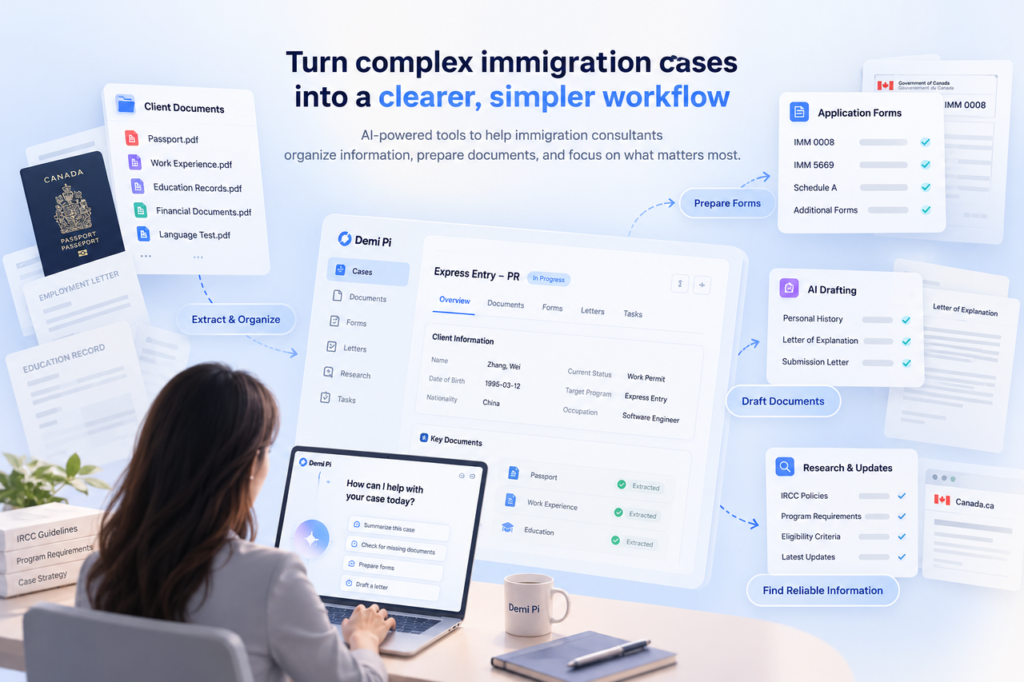
- extract and organize information from client documents
- prepare application forms using existing case information
- generate structured first drafts of letters and supporting documents
- identify missing or inconsistent information
- summarize case histories and client communications
- organize documents and case information
- reduce repetitive administrative work
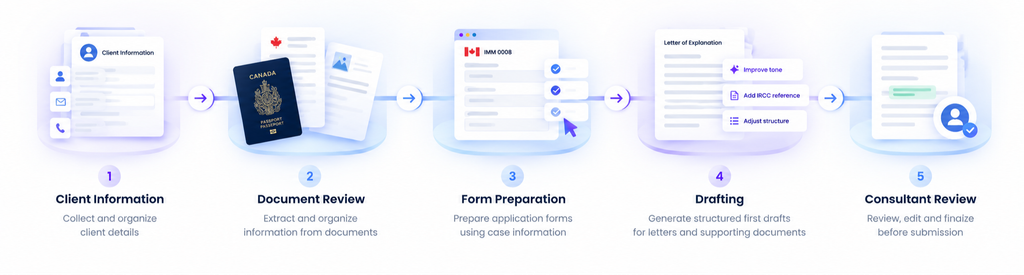
A typical workflow could look like:
Client Information → Document Review → Form Preparation → Drafting → Consultant Review
The goal is not to remove the consultant from the process. It is to make case preparation more efficient.
Professional Judgment Still Matters
AI-generated information should not automatically become the final answer. Immigration cases involve context, evidence, professional responsibility and decisions that may have a major impact on a client’s future.
AI can help prepare information, but consultants should still review:
- factual accuracy
- dates and timelines
- supporting evidence
- missing or conflicting information
- forms and drafted documents
- final case strategy
A useful AI workflow should therefore follow a simple principle: AI prepares. The consultant reviews and decides.
Data Security Should Be Part of the Decision
Immigration files contain sensitive information, including passports, financial documents, employment records and personal histories. Before choosing an AI platform, firms should understand how client information is handled.
Important questions include:
- Where is the data stored?
- Who can access it?
- Is client information used to train AI models?
- How long is information retained?
- Can data be deleted?
- What security and permission controls are available?
AI functionality is important, but for professional immigration work, privacy and security should be considered from the beginning.
How to Evaluate an Immigration AI Platform
When comparing AI tools, feature lists alone are not enough.
Immigration consultants should ask:
Does the system understand the case context?
- AI is more useful when it can work with relevant client information and documents rather than only responding to isolated prompts.
Does it reduce duplicate work?
- Information should move through the workflow without needing to be entered repeatedly.
Can the consultant review the output?
- Important AI-generated information should be easy to inspect, edit or reject.
Does it fit the firm’s existing workflow?
- A good AI tool should simplify the process, not introduce additional steps.
Can it be tested on a realistic case?
- The best way to evaluate a platform is to test it on real working scenarios such as document review, form preparation or drafting.
Where DemiPi Fits
At Demi Pi, we are building AI-powered tools around the everyday case preparation workflow of immigration professionals.
Our focus includes:
- document organization and information extraction
- form preparation
- AI-assisted drafting
- case information management
- workflow automation
- consultant review
The goal is simple: help immigration consultants spend less time on repetitive case preparation and more time reviewing cases, understanding clients and making professional decisions.
We believe the future of immigration technology is not about replacing professionals.
It is about giving them better tools.
Experience decides. AI assists.
← All articles